HubSpot vs Zoho CRM for a small agency in 2026
HubSpot wins on polish and ease of use; Zoho CRM wins on price. For most small agencies just starting out, HubSpot's free tier is the safer choice. For agencies that have outgrown free HubSpot and are wincing at paid pricing, Zoho does most of the same job for roughly a quarter of the cost.
If you're comparing these two, you've likely already used or looked at HubSpot and are wondering whether Zoho CRM can do the same job for meaningfully less money. It's a fair question — and the honest answer is: mostly yes, with a few real trade-offs worth knowing before you switch or commit a whole team.
Both are genuine CRMs, not stripped-down lead trackers. The gap between them is mostly about polish, ecosystem size, and price — not core capability. Let's put real numbers on that gap.
What Zoho CRM is, in plain terms
Zoho CRM is a standalone CRM that's part of a much larger Zoho suite of business software (email, accounting, HR — dozens of apps that all connect together). On its own, it covers contacts, deal pipelines and workflow automation via a feature called "Blueprint," which lets you enforce a required process — for example, blocking a deal from moving to "won" until a contract is attached, which stops sloppy record-keeping before it becomes a habit.
What HubSpot is, in plain terms
HubSpot covers the same ground — contacts, pipeline, automation — with a noticeably more polished interface, deeper integrations with tools like Gmail, Outlook and Slack, and a genuinely usable free tier that many agencies never outgrow.
The real cost gap, with numbers
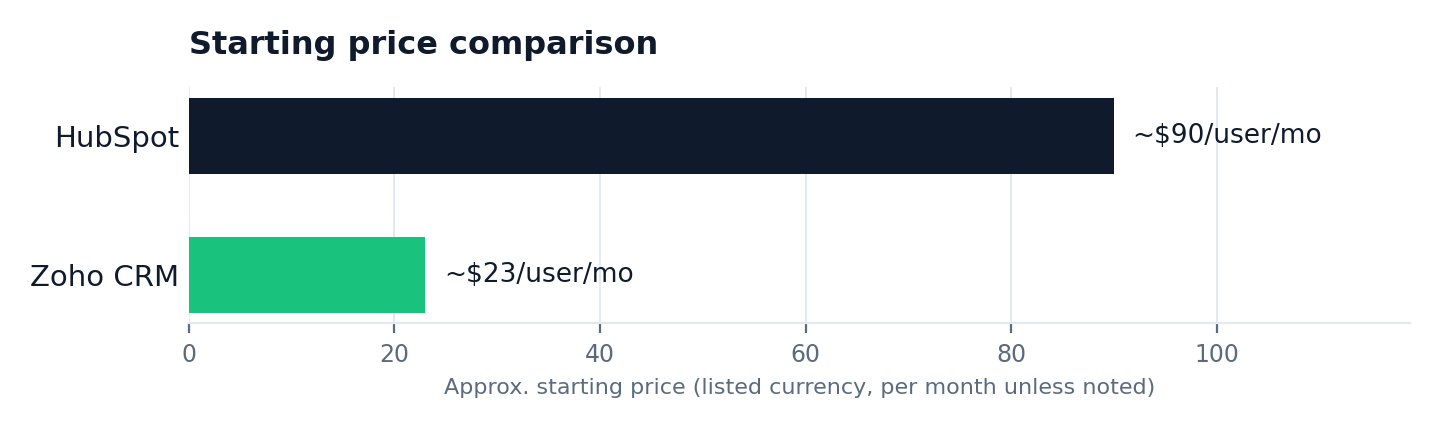
Zoho CRM Professional runs about $23/user/month against HubSpot's roughly $90/user/month at the equivalent Professional tier — for a 10-person team, that's a difference of around £6,500 a year. That's not a rounding error; it's real money that could go toward ads, hires, or margin. Over three years, that gap alone is close to £20,000 for a modest-sized team.
What you give up moving to Zoho
A smaller integration marketplace (fewer one-click connections to other tools you might already use), a less polished interface that takes a little longer to feel intuitive, and a smaller support community when you hit an odd edge case — Google a HubSpot problem and you'll find ten forum answers; Google a niche Zoho problem and you might find one. None of these are dealbreakers, but they're real, and worth testing yourself before committing a whole team to the switch.
A real scenario: the agency that made the switch
Picture an 8-person digital agency on HubSpot Professional, paying roughly £720/month. Moving to Zoho CRM Professional drops that to around £184/month — a saving of over £6,400 a year, enough to cover a part-time hire or a serious ad budget test. The team reported a two-week adjustment period on the interface, then no meaningful difference in how they actually used it day to day.
How to test the switch properly
Don't migrate blind. Run a real two-week trial in Zoho with five to ten of your actual current deals mirrored across both systems, and have your team log activity in both. If the £6,500/year saving clearly outweighs the extra friction your team reports, switch. If the friction is bigger than expected, stay on HubSpot and treat the saving as the cost of a smoother tool.
Where this fits in the bigger CRM decision
If you haven't yet committed to HubSpot at all, it's worth reading our wider best CRM for a small agency comparison first, which also covers GoHighLevel for agencies that resell CRM access to their own clients — a genuinely different use case from either HubSpot or Zoho.
Head to head
| HubSpot Winner on polish | Zoho CRM Winner on price | |
|---|---|---|
| Professional tier price | ~$90/user/mo | ~$23/user/mo |
| 10-person team, annual cost | ~£8,600/yr | ~£2,200/yr |
| Interface polish | Best in class | Solid, less refined |
| Integrations | Largest ecosystem | Smaller, connects to wider Zoho suite |
| Automation depth | Strong, AI-assisted | Good, via Blueprint workflows |
| Best for | Agencies prioritising ease of use | Agencies prioritising cost per seat |
Frequently asked questions
Is Zoho CRM as good as HubSpot?
It covers most of the same core ground — contacts, pipeline, automation — at a much lower price, with a smaller integration ecosystem and slightly less polished interface.
How much cheaper is Zoho than HubSpot in practice?
At the professional tier, roughly $67/user/month cheaper — around £6,500/year for a 10-person team, and closer to £20,000 over three years.
Should a brand-new agency start with Zoho to save money?
Not necessarily — HubSpot's free tier costs nothing at the start, so most new agencies should begin there and only consider Zoho once paid HubSpot pricing becomes a real concern.
Is switching CRMs from HubSpot to Zoho difficult?
Contact and deal data exports/imports cleanly via CSV; custom automation and pipeline stages need manual rebuilding, so budget a few hours, not days.
How long does it take a team to adjust to Zoho's interface after HubSpot?
Most teams report a genuine but short adjustment period — around two weeks — before the interface stops feeling like friction.
Does Zoho integrate with tools like Gmail and Slack?
Yes, though the integration marketplace is smaller than HubSpot's — check your specific must-have tools before committing a whole team.
The bottom line: HubSpot for ease, Zoho for a genuinely meaningful cost saving once your team is past free-tier size — test both with real deals before deciding.
The rest of this CRM series
This article is part of a full CRM series for small agencies: best CRM for a small agency, best CRM for consultants, HubSpot vs GoHighLevel, HubSpot vs Pipedrive, HubSpot vs Zoho, ActiveCampaign vs HubSpot, HubSpot's free CRM reviewed, HubSpot Free vs Starter, and how to set one up in a week.