GetResponse vs Mailchimp in 2026: which should you use?
GetResponse wins on value. It bundles email, automation, landing pages and webinars at a lower price than Mailchimp charges for email alone once your list grows past a few thousand contacts. Mailchimp still wins on brand familiarity and simple Shopify integrations.
If you're comparing these two, you've probably heard of Mailchimp already — it's the household name in email marketing — and you're wondering whether the lesser-known GetResponse is actually worth switching to, or just a cheaper knock-off. Here's the honest answer: it's not a knock-off, and for most small businesses it's genuinely the better deal, with real numbers to back that up.
Both are email marketing tools at their core — software that lets you build and send emails to a list of subscribers, automatically, on a schedule or triggered by their behaviour. The real differences show up in pricing, what's bundled in, and how each one grows with you as your list scales.
Where the price gap actually bites
Mailchimp's pricing climbs fast with list size — a 5,000-contact list can cost noticeably more on Mailchimp's Standard tier than the equivalent on GetResponse, which also throws in landing pages (standalone web pages for a specific offer or sign-up) and webinar hosting that Mailchimp charges extra for or doesn't offer at all. At 10,000 contacts, the gap widens further, often by £20-40/month depending on the exact tier comparison.
Automation depth, explained plainly
Both offer a visual automation builder — you drag boxes onto a canvas to build a sequence like "if someone signs up, wait one day, send email A, if they click, send email B." GetResponse's builder includes more advanced conditional logic and lead scoring on its lower tiers; Mailchimp reserves its deeper automation features for higher-priced plans, so you may need to pay more just to unlock logic GetResponse includes from the start.
Where Mailchimp still wins
If you run a Shopify or WooCommerce store, Mailchimp's e-commerce integrations are more mature and widely documented online, meaning setup guides and troubleshooting help are easier to find. Its brand recognition also means fewer client questions when you name-drop it in a proposal — some people simply trust a name they've heard of, which has real value in a client-facing pitch.
A worked cost comparison at three list sizes
At 1,000 contacts, both platforms cost roughly £13-19/month — close enough that features should decide it. At 5,000 contacts, GetResponse typically runs £30-45/month against Mailchimp's £50-70/month for comparable features. At 10,000 contacts, the gap can exceed £40/month, which adds up to several hundred pounds a year for a growing list.
The honest recommendation
For agencies managing multiple clients or a growing list, GetResponse's pricing model rewards you as you scale, and the bundled landing pages remove the need for a separate tool. For a single small e-commerce store bolting email onto an existing Shopify setup, Mailchimp's native integration may save real setup time in the first week, even at a higher ongoing cost.
How to test this yourself in an afternoon
Sign up for both free trials, import the same 100 real contacts into each, and build one identical welcome email in both. Notice which one felt faster to finish and which interface you'd rather open every week — that felt-experience matters more for long-term use than any feature comparison table, since you'll be the one opening it regularly.
Head to head
| GetResponse Winner on value | Mailchimp | |
|---|---|---|
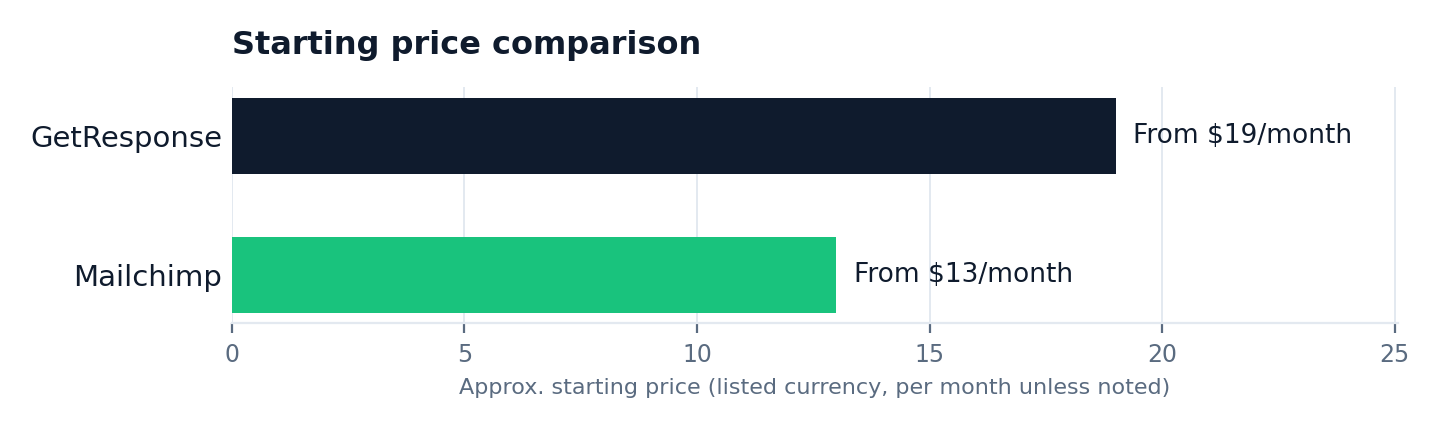
| Starting price | From $19/month | From $13/month (limited features) |
| Cost at 5,000 contacts | ~£30-45/mo | ~£50-70/mo |
| Landing pages | Included | Extra/limited |
| Webinars | Included on mid tiers | Not offered |
| Automation depth | Strong on lower tiers | Reserved for higher tiers |
| E-commerce integrations | Good | Best in class |
Frequently asked questions
Is GetResponse cheaper than Mailchimp?
Generally yes, especially as list size grows — GetResponse's pricing scales more gently and includes landing pages and webinars that Mailchimp charges extra for.
Which is better for e-commerce, GetResponse or Mailchimp?
Mailchimp has more mature Shopify and WooCommerce integrations, with more documentation available. For agencies or non-e-commerce email marketing, GetResponse offers more for the price.
Does GetResponse have automation like Mailchimp?
Yes, and GetResponse's automation logic is generally more advanced on comparable pricing tiers, without needing to pay for a higher plan to unlock it.
Is switching from Mailchimp to GetResponse difficult?
No — both support CSV export/import of contact lists, and GetResponse offers guided migration tools for moving existing campaigns across.
At what list size does the price gap become significant?
Around 5,000 contacts is where the difference starts to add up meaningfully — by 10,000 it can exceed £40/month, or several hundred pounds a year.
Does Mailchimp's brand recognition actually matter for a small business?
It can, mainly in client-facing proposals where a familiar name reduces friction — for your own internal use, it shouldn't outweigh the real cost and feature differences.
The bottom line: GetResponse for value and growing lists, Mailchimp for pure Shopify simplicity. If you're weighing a third, funnel-focused option instead, see our ClickFunnels review.
The rest of this email marketing series
Part of a full series on email marketing platforms for small businesses and agencies: GetResponse vs Mailchimp, GetResponse review, best email marketing for small business, best email platform for agencies, Kit vs GetResponse, ClickFunnels review, and email marketing for consultants.